

Braces systems: the treatment process and types of systems.
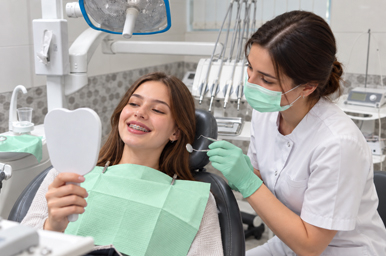
In modern dentistry, fixed orthodontic appliances - braces - are used to correct tooth alignment and bite abnormalities. They are attached to the tooth enamel using special composite materials.
If braces are required for medical or aesthetic reasons, the choice of a specific type should be made carefully, taking into account not only the cost but also the complexity of the condition, lifestyle, and work environment. The appliance should not cause significant discomfort in everyday life or communication with other people.
What Braces Consist Of
The system consists of the brackets themselves and an orthodontic archwire. Brackets are attached individually to each tooth and are designed to transfer force from the archwire to the teeth. Under this pressure, the teeth gradually move into their correct position.
Principle and Sequence of Treatment
It is important to understand that there is no single treatment option suitable for everyone. Consult your dentist about which treatment method is best for your particular situation. In addition to the initial consultation, a thorough diagnosis of your individual case will be required. Diagnostic procedures may include special X-rays, a complete photographic record of the initial condition, and dental impressions for precise calculations and treatment planning.
If your dentist recommends that you consult an orthodontist because of tooth or jaw misalignment, you should take this recommendation seriously. There are no strict age limits for bite correction. Treatment can begin from the age of 6-7 using removable appliances such as plates, or fixed appliances. Partial braces can also be placed on selected teeth. You can correct your bite or tooth alignment in Kropyvnytskyi at our clinic by making an appointment with our administrator in advance.
Correcting the bite can make it easier to care for your teeth, which may reduce the risk of caries, gum and periodontal problems, and temporomandibular joint disorders. It can also improve facial and smile aesthetics as well as chewing function.
Most often, an orthodontist corrects crooked teeth or malocclusion using braces. However, additional appliances and devices may sometimes be required, such as mini-implants, fixed appliances, and intermaxillary elastics. Fortunately, advanced technologies in orthodontics continue to improve, providing more opportunities to achieve an attractive smile.
Before braces are installed, preliminary preparation may be required. Such preparation is necessary if the patient has:
- carious cavities
- inflammatory conditions in the oral cavity
- dental deposits, including tartar and soft plaque
- atypical positioning of wisdom teeth
Along with these stages, a thorough diagnosis is carried out. After that, the type of braces can be selected and the system can be installed.
Types of Braces
Modern dentistry offers a wide range of treatment options for crooked teeth and malocclusion. At NikaDent clinic, a qualified orthodontist will select the most appropriate treatment option, while a wide range of braces makes the treatment process more effective and comfortable.
Metal Braces
They consist of two main components:
- metal brackets attached to the teeth;
- a metal archwire that passes through them and applies pressure to the teeth, gradually moving them into the required position.
According to the method used to secure the archwire in the bracket, they can be:
- ligature braces, where the archwire is attached to the brackets using ligatures or elastic bands;
- self-ligating braces, where the archwire is secured in the bracket using a built-in locking mechanism.
Ceramic Braces
These belong to the category of aesthetic braces. They are less noticeable on the teeth compared with metal braces, but they are also more fragile. Therefore, patients should take extra care when wearing this type of system. According to the method of archwire attachment, ceramic braces can be:
- ligature;
- self-ligating.
Sapphire Braces
This type of braces also belongs to the aesthetic category. They are transparent and less noticeable on the teeth. Sapphire braces are made of synthetic sapphire crystal, a material with a structure and composition similar to natural sapphire, but more affordable. They are not only transparent but also retain their color over time.
This is one of the main advantages of sapphire braces. In addition, the low risk of allergic reactions and a high level of comfort make these braces a popular option. The main disadvantage of this system is its price.
Types of Braces by Fixation Method
Regardless of the material used, braces may be ligature or self-ligating. These terms describe the way the archwire is secured in the brackets. In ligature systems, the archwire is attached to the bracket using elastic rings called ligatures. In self-ligating systems, the archwire is placed into a special slot with a built-in locking mechanism.
Ligature Braces
Ligature braces consist of an archwire, brackets, and fixing elements called ligatures. The ligatures securely hold the archwire in the brackets. One of the disadvantages of such systems is that pressure may not always be distributed evenly, which can sometimes cause discomfort or pain.
If a ligature system is chosen for treatment, regular monthly visits to the orthodontist are usually required.
Self-Ligating Braces
Self-ligating braces are systems that do not require separate ligatures for fixation. Each bracket has a special slot and locking mechanism that allows the archwire to move more freely when excessive force occurs. With this type of system, pressure on the teeth can be distributed more evenly.
Self-ligating braces can be used for various types of malocclusion, and the correction process may be more comfortable for the patient.
In addition to requiring fewer visits to the orthodontist and having a more streamlined appearance, self-ligating braces can apply gentler forces to the teeth compared with traditional ligature systems.
Which Braces Are Better to Choose?
It is impossible to say that one type of braces is universally good and another is not. Each system has its own advantages and disadvantages. The patient's choice depends not only on personal preferences and budget but also on the orthodontist's recommendations. In some clinical situations, only metal braces may be recommended, so patients should be prepared for such considerations.
The duration of treatment is also an important factor for patients, as it directly affects possible limitations and inconvenience in everyday life.
In general, it should be understood that the appearance of braces does not determine the effectiveness of the final treatment result. When choosing a system, it is important to consider
cost, aesthetic preferences, and individual needs. However, the final choice of the orthodontic system should be made only after an appointment with an orthodontist and a detailed consultation based on the necessary diagnostic procedures.
At NikaDent dental clinic, you can receive a full consultation with an orthodontist and, by following the prescribed treatment plan, achieve the desired result - a straight, functional, and comfortable dental alignment.
You can schedule a consultation with our administrator by phone: +38 (066) 721-41-44, +38 (098) 893-24-43.
Or book an appointment online through our website.
We are located at: 76 Verkhnia Bykivska Street, Kropyvnytskyi (formerly Chapaieva Street, near Oblenergo), NikaDent dental clinic.


Patient reviews
The best proof of our work comes from people who have already trusted us with their smile.
Tetiana Mykolaivna
I had two teeth treated at the Nikadent clinic and also had a dental cleaning to remove tartar. I am very happy with the doctors' work! Thank you so much; I will definitely recommend the clinic to everyone I know.

Svitlana Dmytrivna
A huge thank you to the doctors at Nikadent! I am very pleased with their work—they extracted my wisdom tooth completely painlessly! I had been putting off the extraction for a long time because I was terrified of dentists, but when the pain became unbearable, I finally decided to go through with it. My fears turned out to be unfounded!

Larysa Mykolaivna
I am very pleased with the work of the doctors at Nikadent Clinic; they treated the periodontal disease that had been troubling me for a long time! My gums are healthy now—thank you so much! I will recommend your clinic to my friends!
Need a dentist consultation?
Leave a request and we'll take care of the rest — select a specialist and a convenient time for your visit.